Closed Shoulder Trailer Design
The closed shoulder pattern helps promote stable tread wear and reduce irregular shoulder movement in trailer axle positions.

Commercial Truck Trailer Tires
MP993 is built for trailer axle positions where stable wear, low rolling resistance, wet-road control, and casing protection matter most.
Designed for highway and regional trailer applications, MP993 helps fleets manage scrub wear, stone drilling risk, rolling efficiency, and cost per mile.
Closed Shoulder Commercial Truck Trailer Tire
The Muscle Power MP993 is a commercial truck trailer tire designed for highway and regional trailer axle service. Its closed shoulder design helps promote stable wear in free-rolling positions, while the optimized footprint supports wet-road control, low rolling resistance, and consistent road contact.
Trailer tire performance is different from steer and drive performance. A trailer tire must carry load, resist scrub during turns and yard movement, and protect casing value over long operating cycles. MP993 is built for fleets that need a practical trailer tire option focused on predictable wear, casing protection, and cost-per-mile control.
MP993 is a strong fit for dry van, refrigerated trailer, regional freight, and highway trailer axle applications where stable wear, rolling efficiency, and value matter.
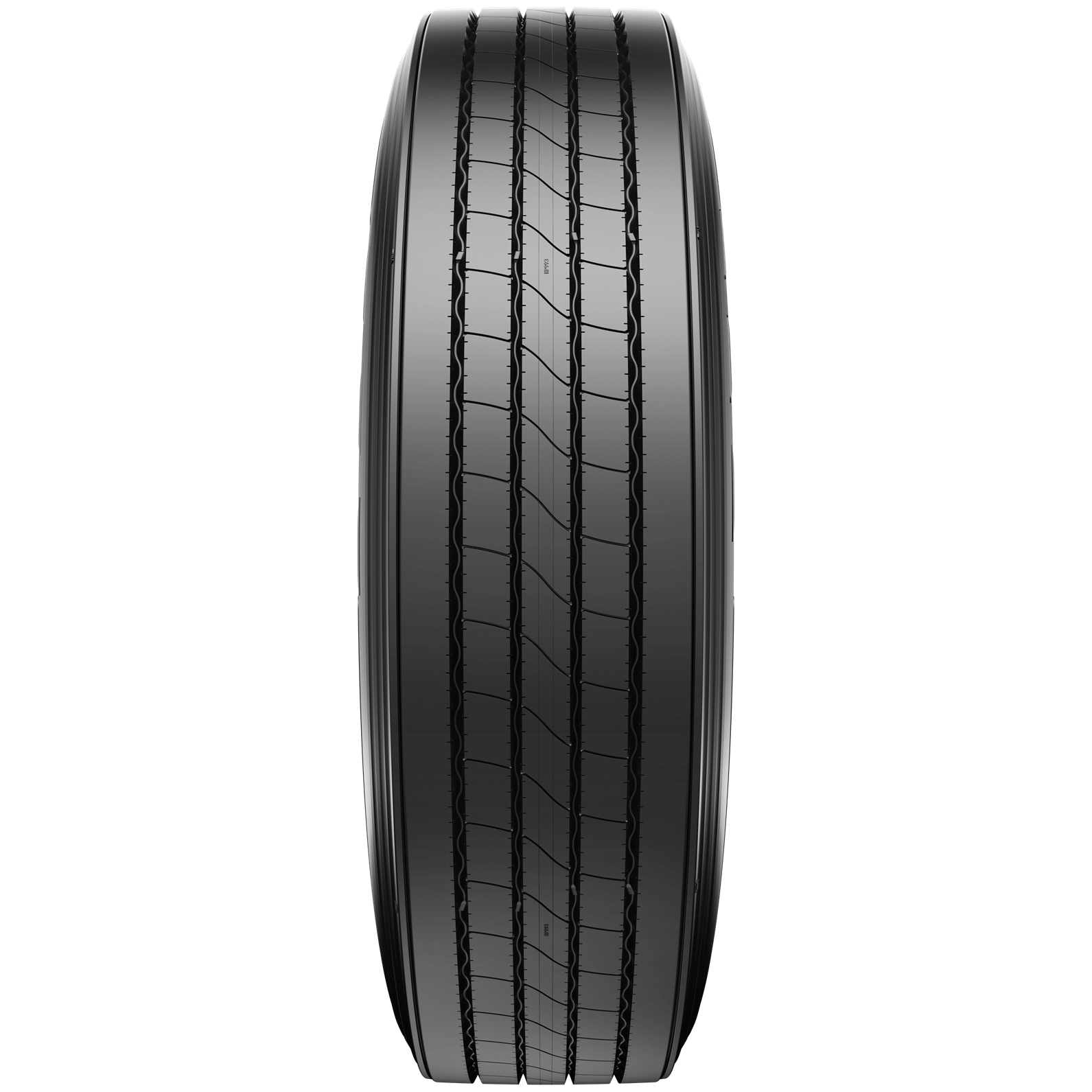 MP993 Front View
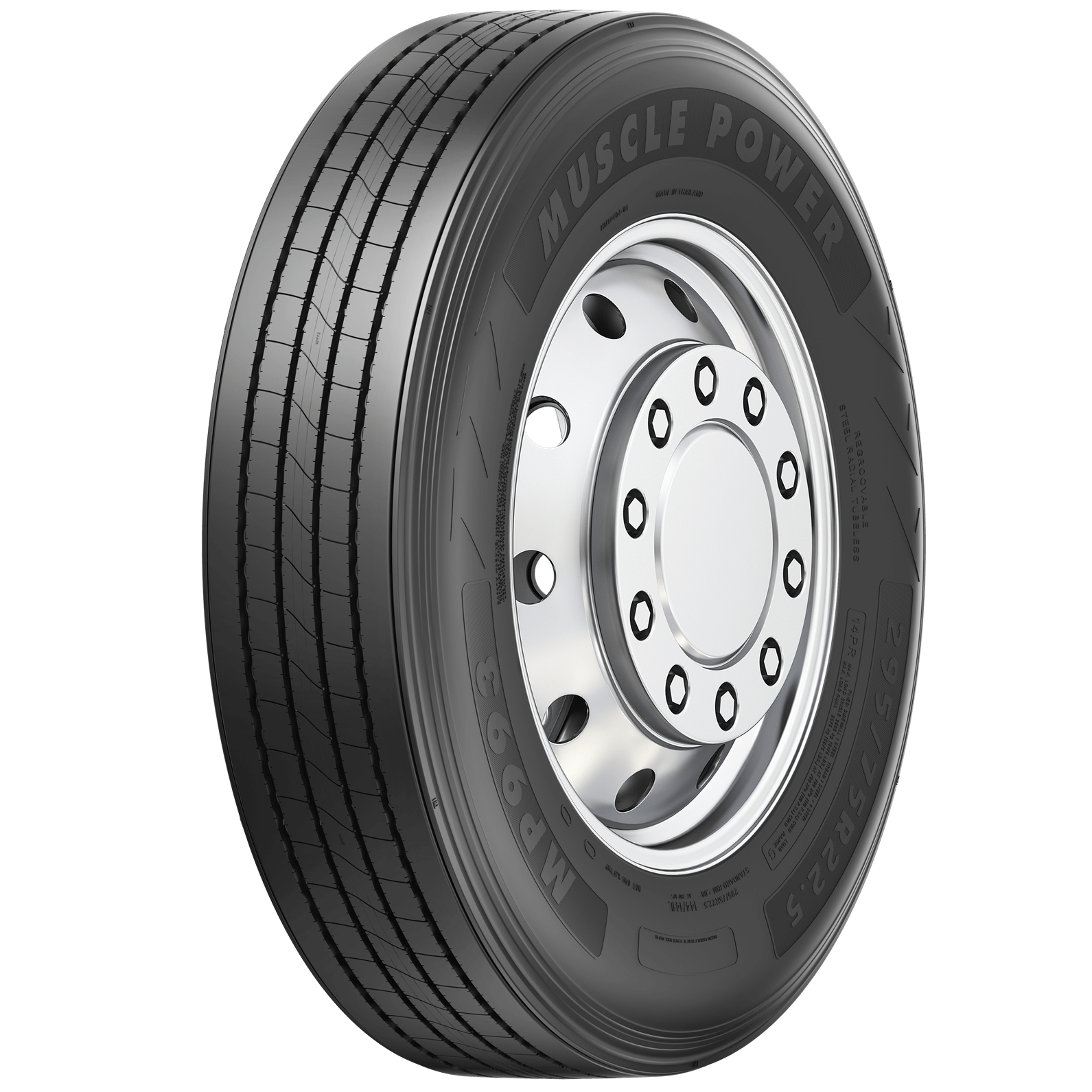 MP993 Angle View
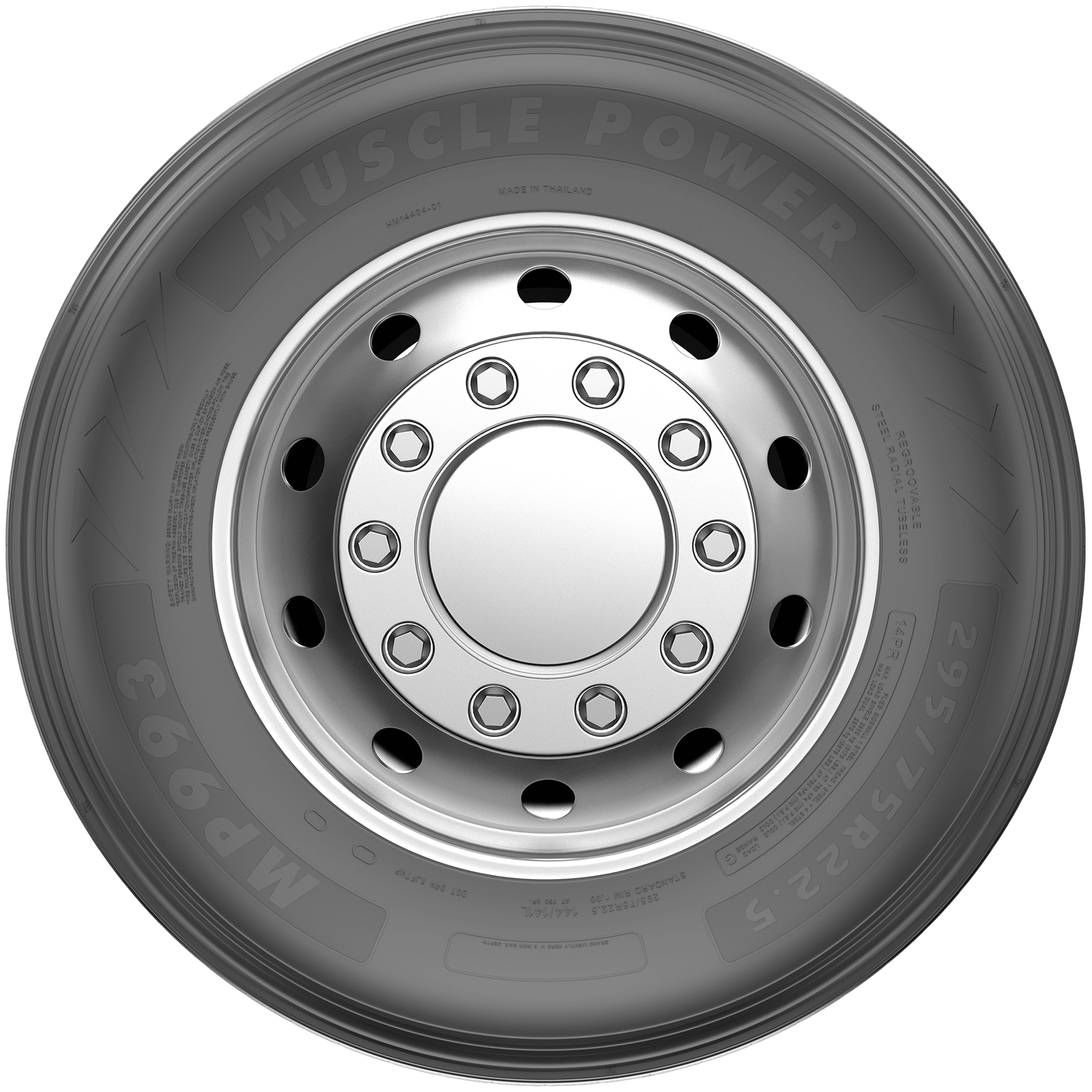 MP993 Side View
The closed shoulder pattern helps promote stable tread wear and reduce irregular shoulder movement in trailer axle positions.
A consistent contact patch helps support even wear, wet-road stability, and dependable free-rolling trailer performance.
Trailer tires spend most of their life rolling without power or steering input. A low rolling resistance design can help support fleet efficiency and fuel-conscious operation.
The tread design helps reduce stone retention and lower the risk of stone drilling damage, supporting casing protection in highway, yard, and regional service.
The footprint and groove design help maintain road contact and water evacuation for trailer axle stability in wet highway conditions.
MP993 is positioned for fleets and dealers that need dependable trailer tire performance, consistent wear, and aggressive value compared with higher-priced premium trailer tire options.
Use the MP993 specification table to match trailer tire size, load range, load index, rim width, inflation pressure, revolutions per mile, and overall diameter to the trailer axle application. Trailer tires should be selected based on actual load, wheel position, inflation pressure, operating route, and trailer type.
| Size | Ply Rating | Load Range | Load Index | Speed Symbol | Outside Diameter | Section Width | Tread Depth 32nds | Rim | Single Max Load/Pressure | Dual Max Load/Pressure | Static Load Radius | Revs Per Mile | Weight lbs | Tire Type |
|---|---|---|---|---|---|---|---|---|---|---|---|---|---|---|
| 295/75R22.5 | 14 | G | 144/141 | L | 39.53 | 11.7 | 13 | 9 | 6175/110psi | 5675/110psi | 19.4 | 498 | 102.1 | TL |
Trailer Tire Problem Solving
| Problem | Why It Happens | MP993 Solution |
|---|---|---|
| Shoulder Scrub | Trailer tires drag sideways during turns, backing, docking, and yard movement. | Closed shoulder design helps promote stable trailer axle wear. |
| Stone Drilling | Stones can lodge in grooves and work toward the casing. | Tread features help reduce stone retention and protect casing value. |
| Rolling Resistance | Trailer tires roll continuously under load. | Low rolling resistance focus supports fleet efficiency. |
| Wet-Road Instability | Trailer axles need consistent contact in rain and highway spray. | Optimized footprint helps support wet-weather performance. |
| Irregular Wear | Underinflation, misalignment, mismatched tires, and suspension issues can shorten tire life. | Stable tread design plus proper maintenance supports predictable wear. |
| Cost Per Mile Pressure | Trailer fleets need reliable wear at a competitive replacement cost. | MP993 is positioned as a high-value trailer tire for fleets and dealers. |
Get manufacturer-direct access to Muscle Power commercial truck tire programs.
Buying for a single truck? Use Buy Online when available or contact a local Muscle Power dealer.
Trailer Tire Education
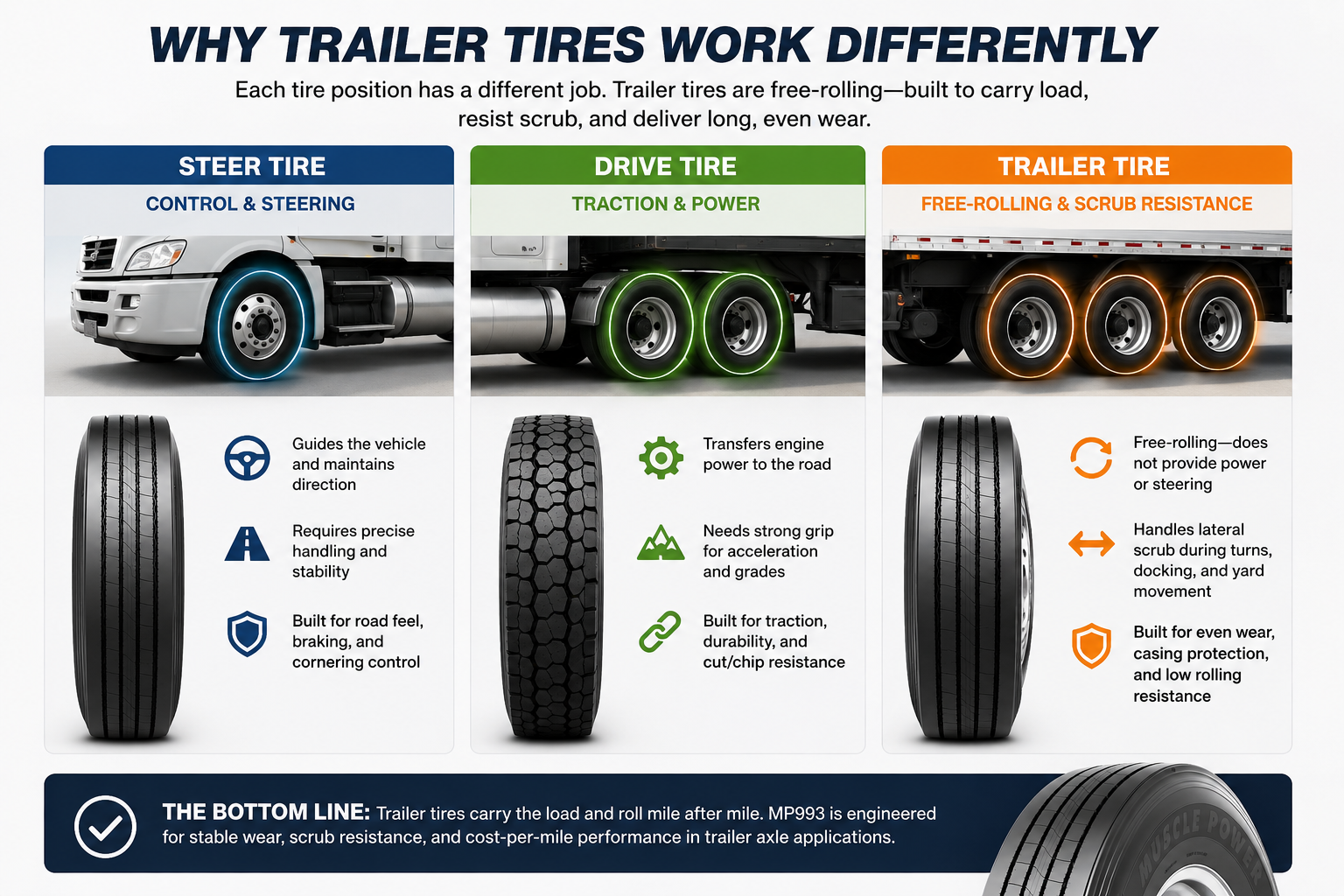
Click image to enlarge
Control and front axle stability.
Traction and torque.
Free-rolling load, scrub resistance, and even wear.
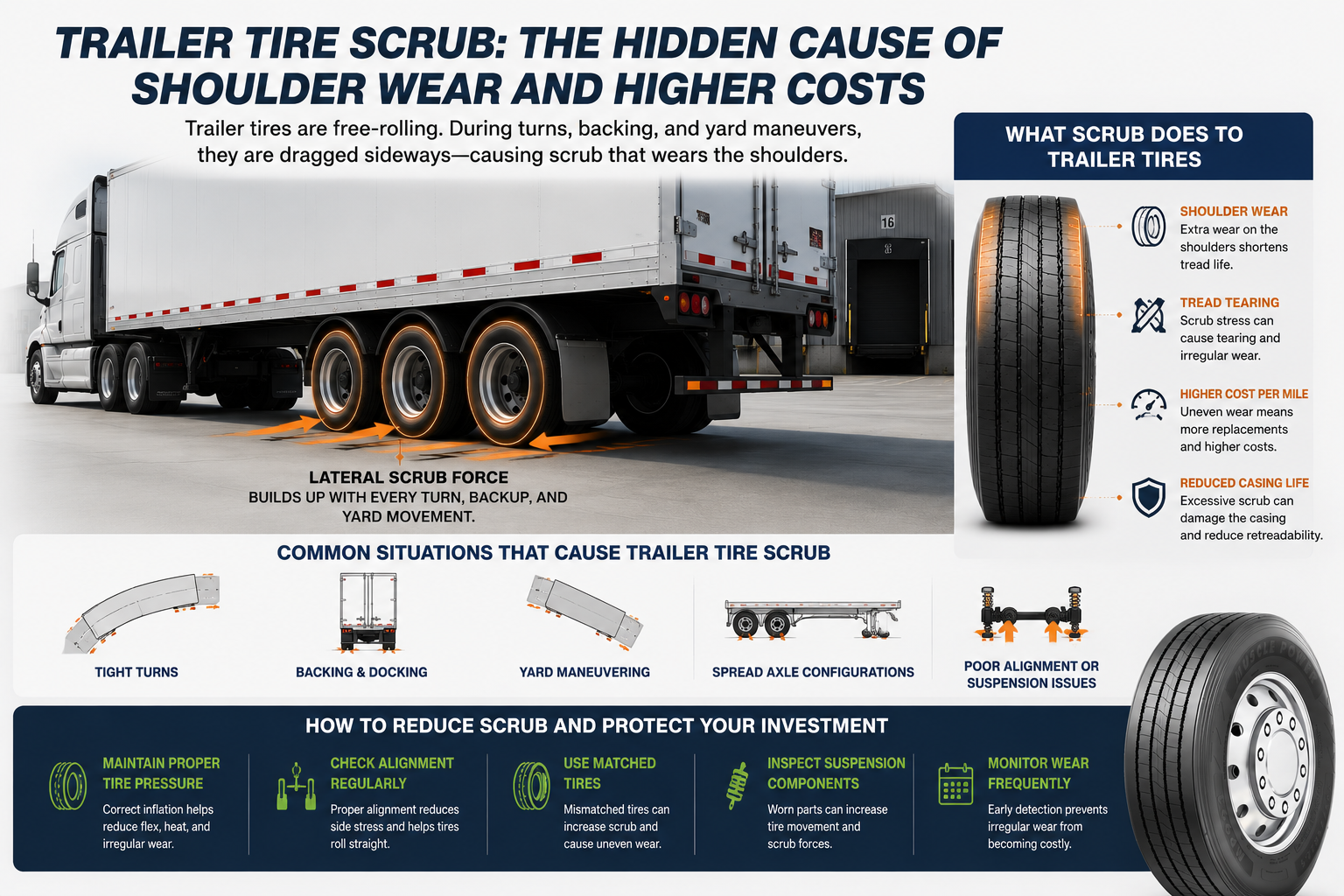
Trailer tires work in free-rolling axle positions. They do not steer the truck like front axle tires, and they do not transfer torque like drive tires. Instead, they carry load, roll continuously, and absorb lateral scrub during turns, docking, backing, and tight yard movement.
This is why trailer tires often face shoulder wear, scrub wear, flat spotting, and casing stress in different ways than steer or drive tires. A good commercial trailer tire needs stable tread contact, resistance to irregular wear, and a design that supports long, consistent rolling performance.
The MP993 is designed around trailer axle demands. Its closed shoulder pattern helps promote stable wear, while the optimized footprint supports wet weather performance and low rolling resistance in highway and regional trailer applications.
Click image to enlarge
Lateral stress increases when trailers pivot through tight routes.
Low-speed maneuvers can drag trailer tires sideways.
Scrub can accelerate shoulder wear and irregular tread patterns.
Predictable wear helps fleets control trailer tire value.
Trailer tire scrub happens when trailer tires are dragged sideways during turns, backing, docking, tight yard movement, or spread-axle operation. Unlike steer tires, trailer tires do not turn to follow the direction of travel, so they can experience lateral stress across the tread.
Over time, scrub can cause shoulder wear, tread tearing, irregular wear patterns, and reduced tire life. This is especially important for fleets running local delivery, distribution routes, tight docks, drop-and-hook operations, or spread-axle trailers.
To reduce trailer tire scrub damage, fleets should maintain correct inflation pressure, inspect suspension and alignment, avoid mismatched tires, monitor shoulder wear, and choose trailer tires designed for stable free-rolling performance. MP993 is positioned as a value-focused trailer tire for fleets that need predictable wear, casing protection, and dependable trailer axle performance.
Click image to enlarge
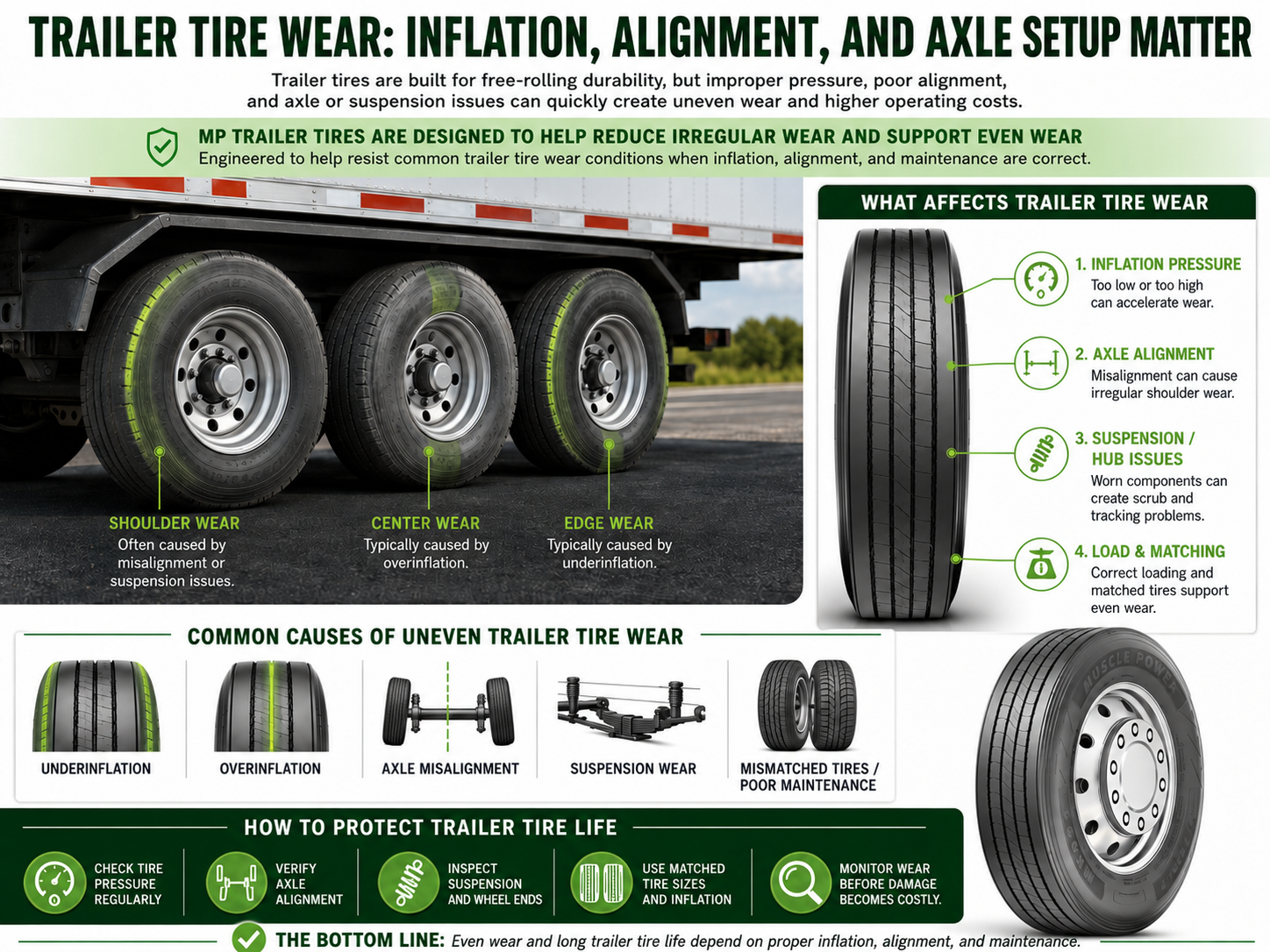
Trailer tires are built for free-rolling durability, but improper pressure, poor alignment, axle issues, suspension problems, mismatched tires, and poor maintenance can quickly create uneven wear and higher operating costs.
MP trailer tires are designed to help reduce irregular wear and support even wear when the tire is used in the correct application and inflation, alignment, and maintenance are correct. No trailer tire can overcome poor pressure maintenance, bad alignment, damaged suspension components, or improper loading, but the right tread design and casing support can help protect trailer tire value.
To protect trailer tire life, fleets should check tire pressure regularly, verify axle alignment, inspect suspension and wheel ends, use matched tire sizes and inflation pressures, and monitor wear before small problems become costly.
Trailer tire specifications help match the tire to the correct trailer axle, wheel, load, pressure, and route. The key specs include tire size, ply rating, load range, load index, speed symbol, tread depth, rim width, maximum load, inflation pressure, revolutions per mile, weight, and tire type.
MP993 is currently listed in 295/75R22.5, a common low-profile commercial truck tire size for trailer axle applications.
MP993 is listed as 14-ply / Load Range G. In modern radial truck tires, ply rating is best understood as a load/strength category, not a literal count of physical plies.
MP993 uses a 144/141L service description. Load index 144 equals about 6,175 lb in single use, while load index 141 equals about 5,675 lb in dual use when properly inflated and used within rated conditions. For most trailer axle positions, the dual load rating is usually the more relevant number.
The L speed symbol means the tire is rated up to 75 mph under proper load, pressure, and service conditions. Legal speed limits, heat, load weight, inflation pressure, and maintenance still matter.
MP993 is listed with 13/32 original tread depth, supporting free-rolling trailer axle performance where stable wear, rolling efficiency, and trailer tire value are the priorities.
TL means tubeless, the standard configuration for modern commercial truck tire and wheel assemblies.
Maximum load and pressure must match the trailer axle load, wheel rating, and application. A tire can only carry its rated load when properly inflated.
Trailer Tire Spec Reminder: For trailer axle use, the correct tire is not simply the cheapest tire or the highest ply number. The correct tire is the one that matches the trailer axle load, rim, inflation pressure, route, trailer type, and maintenance program.
Tire Position Guide
Compare Muscle Power tire options by axle position: Steer Tires for control and front axle stability, Drive Tires for traction and torque, All Position Tires for versatile fleet use, and Intermodal Tires for container, chassis, port, and drayage work.
Trailer Tire FAQ
The MP993 is the Muscle Power commercial truck tire designed for trailer axle applications. It is built for free-rolling trailer positions where stable wear, wet-road performance, casing protection, and value per mile are important.
A trailer tire is built for free-rolling axle positions. It does not guide the truck like a steer tire or transfer engine torque like a drive tire. Trailer tires focus on carrying load, resisting scrub, maintaining stable contact, and supporting predictable wear across highway, regional, and yard operations.
Trailer tire shoulder wear is often caused by lateral scrub during turns, backing, docking, tight yard movement, spread-axle operation, underinflation, misalignment, mismatched tires, or worn suspension components. A closed shoulder trailer tire design can help support stable wear, but maintenance and correct application still matter.
Stone drilling can damage the casing when stones become trapped in tread grooves and work deeper into the tire over time. This can reduce tire life and affect casing value. MP993 is designed with features intended to help reduce stone retention and protect against external damage.
MP993 is designed for commercial trailer axle service in highway and regional applications. Its optimized footprint, closed shoulder design, wet weather performance, and low rolling resistance focus make it a practical option for fleets that need dependable trailer tire value on paved routes.
Load Range G is a commercial truck tire load category commonly associated with a 14-ply rating. MP993 uses a 144/141L service description, with load index 144 equal to about 6,175 lb in single use and load index 141 equal to about 5,675 lb in dual use when properly inflated and used within rated conditions. For most trailer axle positions, the dual load rating is usually the more relevant number.
MP993 is positioned as a high-value commercial truck trailer tire for fleets, dealers, and distributors that need dependable trailer axle performance without premium-brand pricing. Its closed shoulder design, optimized footprint, stone drilling protection, and low rolling resistance focus make it a practical trailer tire option for cost-conscious commercial truck operations.
Muscle Power Tires is a manufacturer-direct commercial truck tire brand. We work primarily with wholesale distributors, tire dealers, and large truck fleets. For single-truck or small retail purchases, please buy online when available or contact a local dealer/distributor carrying Muscle Power products.