Closed shoulder design
Helps support stable wear, consistent road contact, and long-mileage highway performance.

Commercial Truck Drive Tires
Muscle Power commercial truck drive tires are built for traction, deep original tread, casing strength, and dependable performance in long-haul, regional, and demanding drive-position applications.
Drive tires transfer engine power to the road. They also handle braking force, torque, loaded miles, wet roads, heat, and the daily punishment of highway and regional work.
Muscle Power offers two commercial drive-position patterns: the MP967 closed shoulder drive tire and the MP968 open shoulder drive tire. Both patterns use 28/32 tread depth and are designed for fleets comparing semi truck drive tires in sizes such as 11R22.5, 11R24.5, and 295/75R22.5, including Load Range H options and a 5-belt commercial truck tire construction package.
Closed Shoulder Commercial Drive Tire
The MP967 is a closed shoulder commercial drive tire designed for long-haul and regional highway applications. Its closed shoulder tread design helps maintain a stable footprint, promote even wear, and support long original tread life.
With 28/32 tread depth, a wide footprint, stone ejectors, and a drive-position tread pattern, MP967 is built for buyers who need traction, casing protection, and dependable drive-position performance.
MP967 is the preferred Muscle Power drive tire when the application calls for highway stability, even wear, closed shoulder performance, and long original tread life.
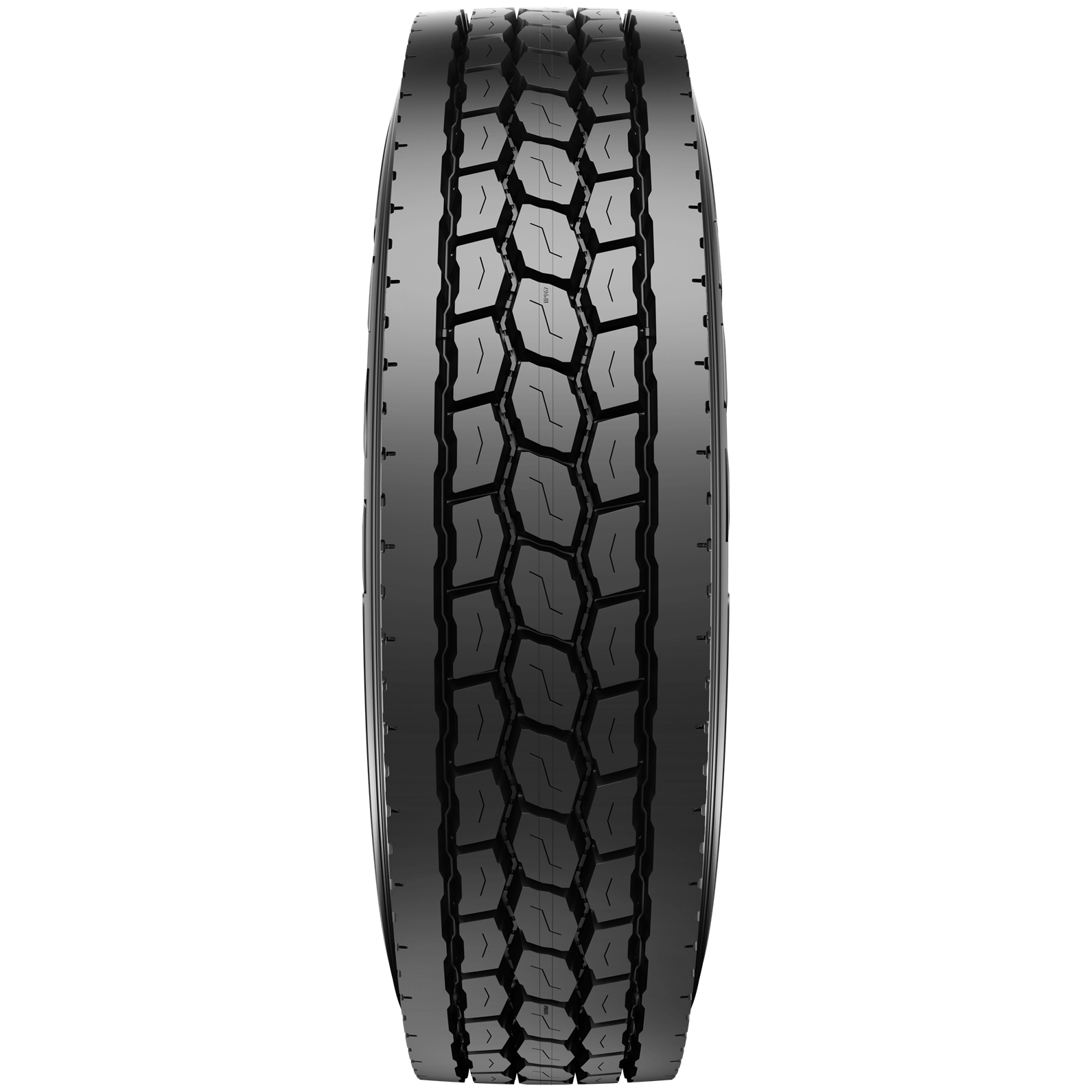 MP967 Front View
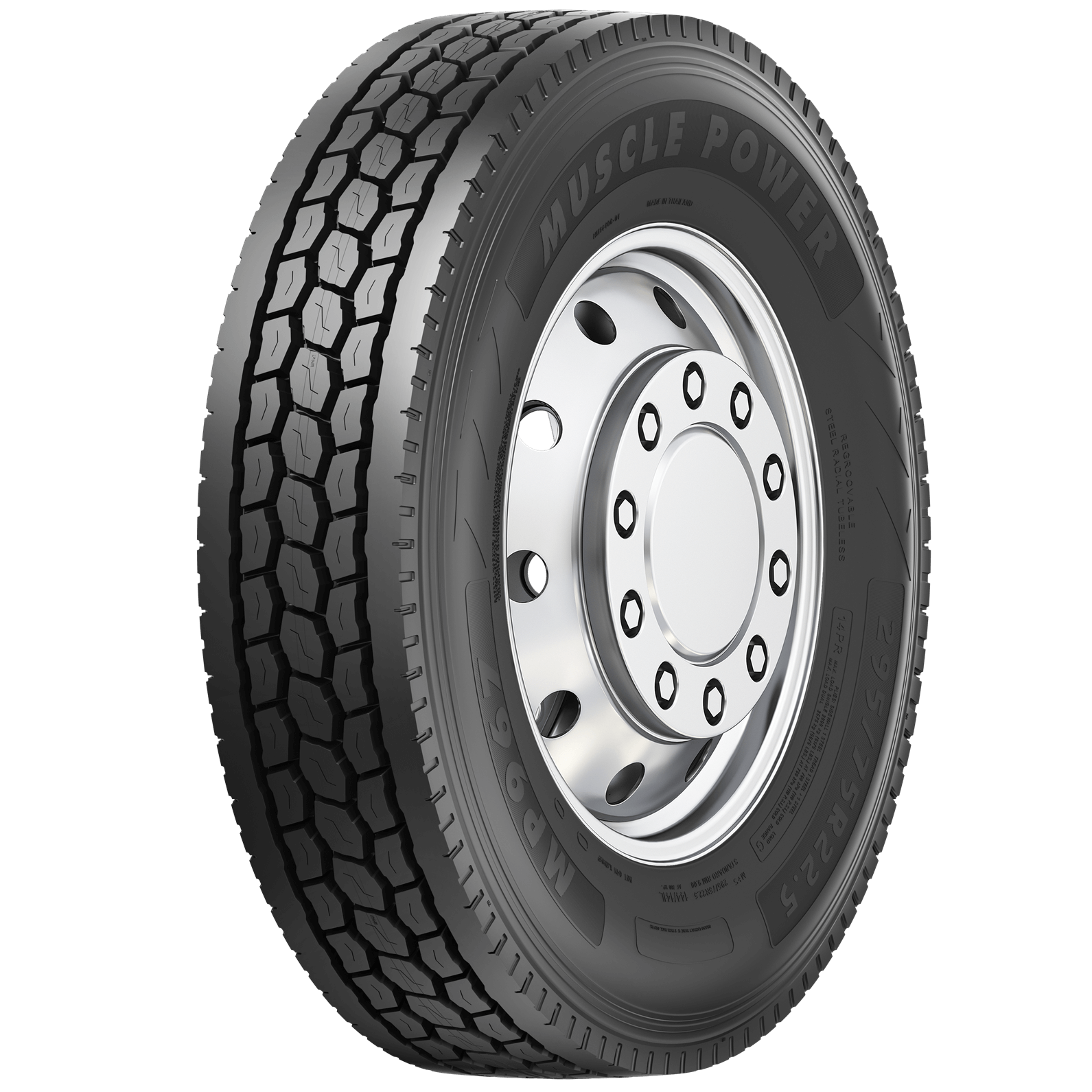 MP967 Angle View
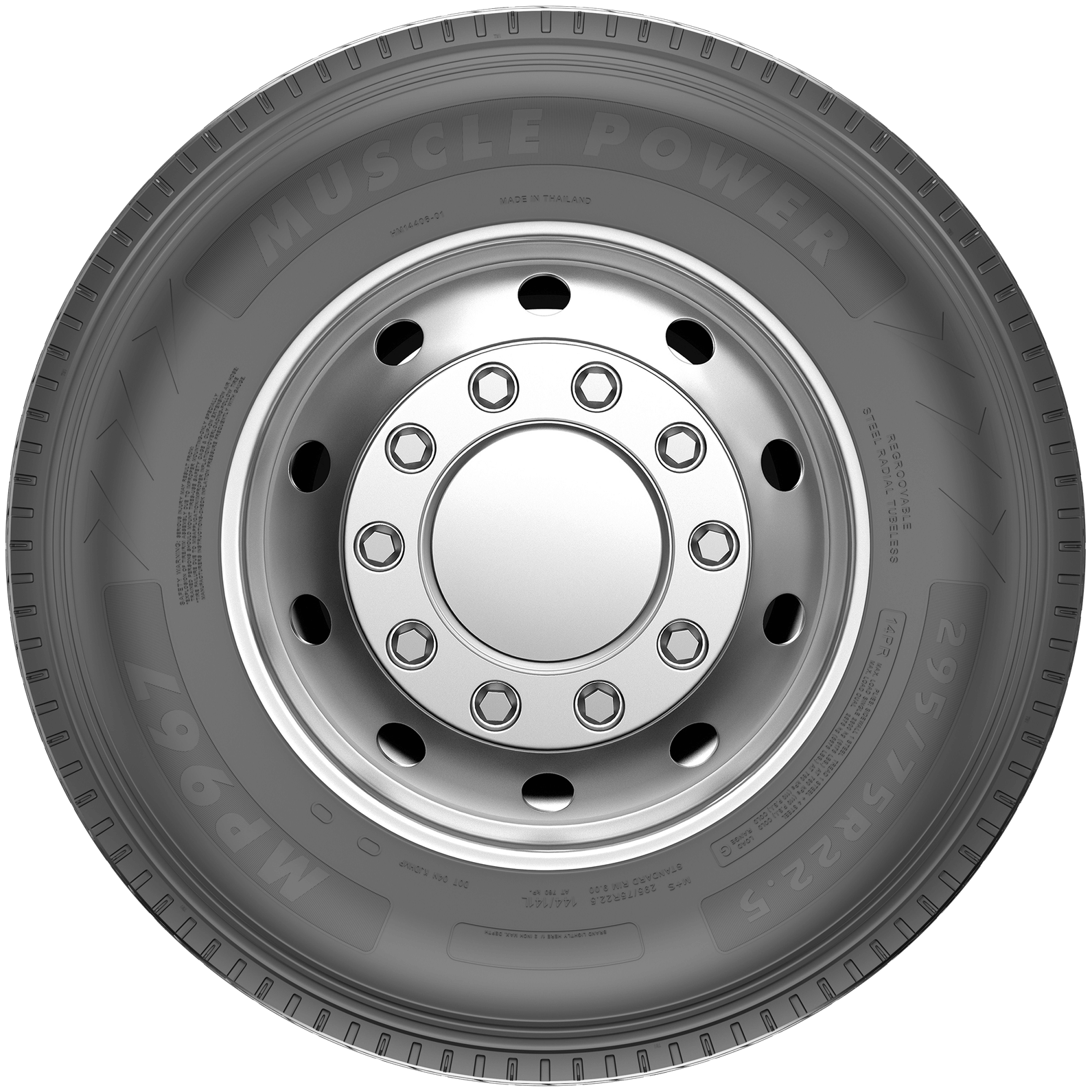 MP967 Tread View
Helps support stable wear, consistent road contact, and long-mileage highway performance.
Provides a deep original tread package for traction and first-life performance.
Helps create greater road contact for traction and drive-position stability.
Help reduce stone retention and protect the casing from stone drilling damage.
Built for torque, braking force, heavy loads, and commercial drive-axle work.
Built for highway miles, loaded applications, and steady drive-position performance. The deep tread package and robust rubber construction help support long original tread life.
| Size | Ply Rating | Load Range | Load Index | Speed Symbol | Outside Diameter | Section Width | Tread Depth 32nds | Rim | Single Max Load/Pressure | Dual Max Load/Pressure | Static Load Radius | Revs Per Mile | Weight lbs | Tire Type |
|---|---|---|---|---|---|---|---|---|---|---|---|---|---|---|
| 11R22.5 | 16 | H | 148/145 | L | 40.67 | 11 | 28 | 8.25 | 6610/120psi | 6005/120psi | 20.1 | 486 | 130.7 | TL |
| 11R24.5 | 16 | H | 149/146 | L | 41.89 | 11 | 28 | 8.25 | 7160/120psi | 6610/120psi | 21.1 | 466 | 138.6 | TL |
| 295/75R22.5 | 14 | G | 144/141 | L | 43.78 | 11.7 | 28 | 9 | 6175/110psi | 5675/110psi | 19.4 | 498 | 124.9 | TL |
| 285/75R24.5 | 14 | G | 144/141 | L | 41.89 | 11.1 | 28 | 8.25 | 6175/110psi | 5675/110psi | 19.8 | 485 | 129.8 | TL |
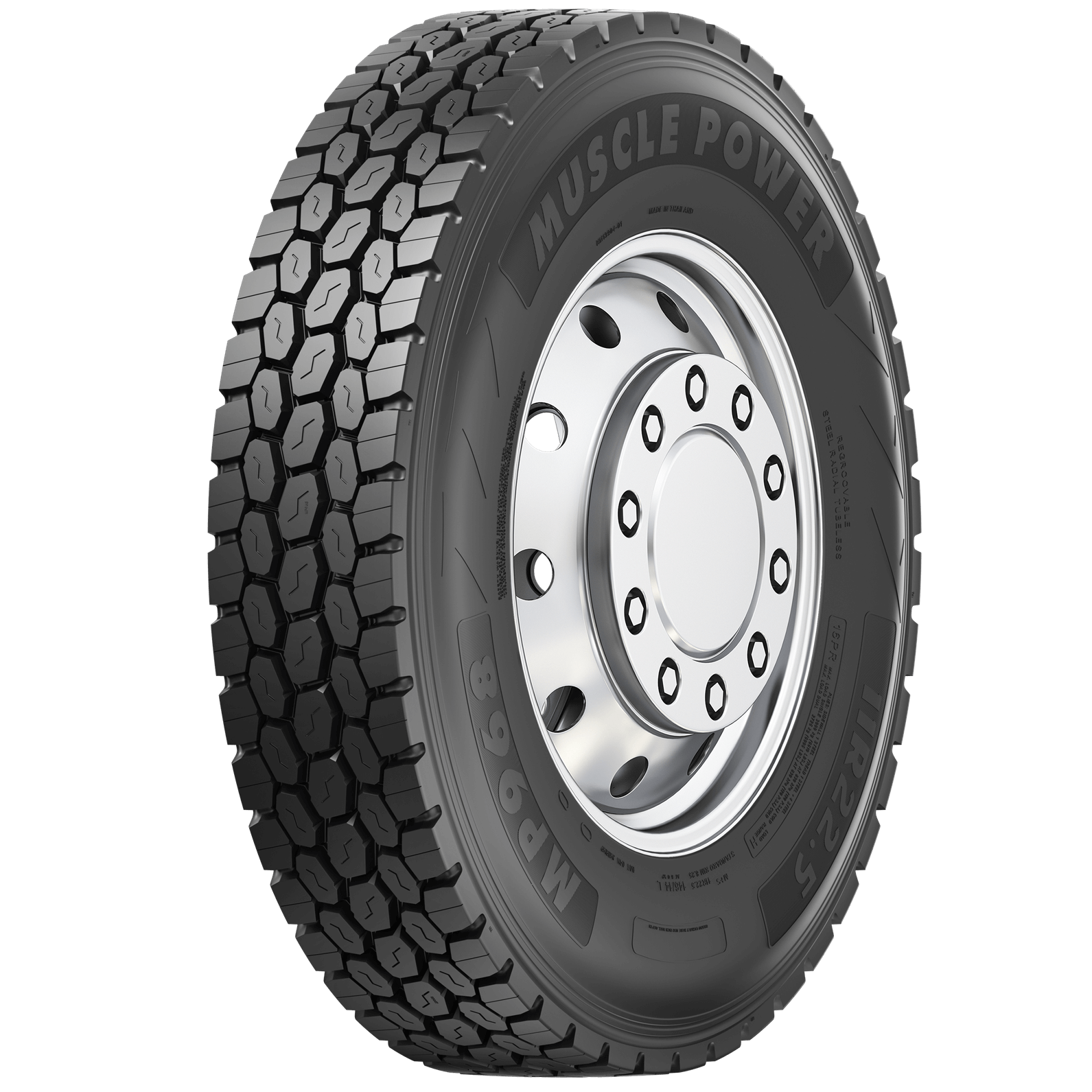
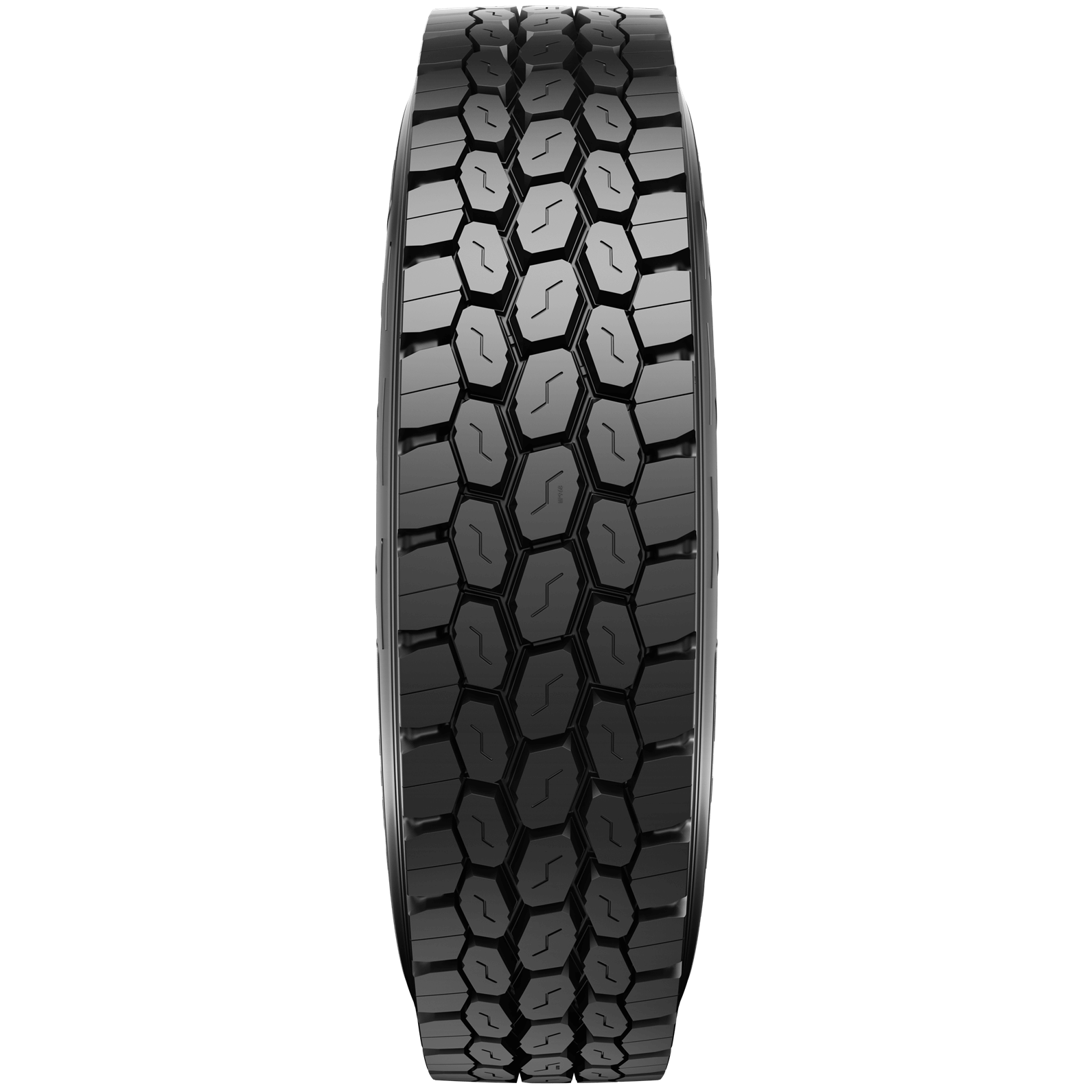 MP968 Front View
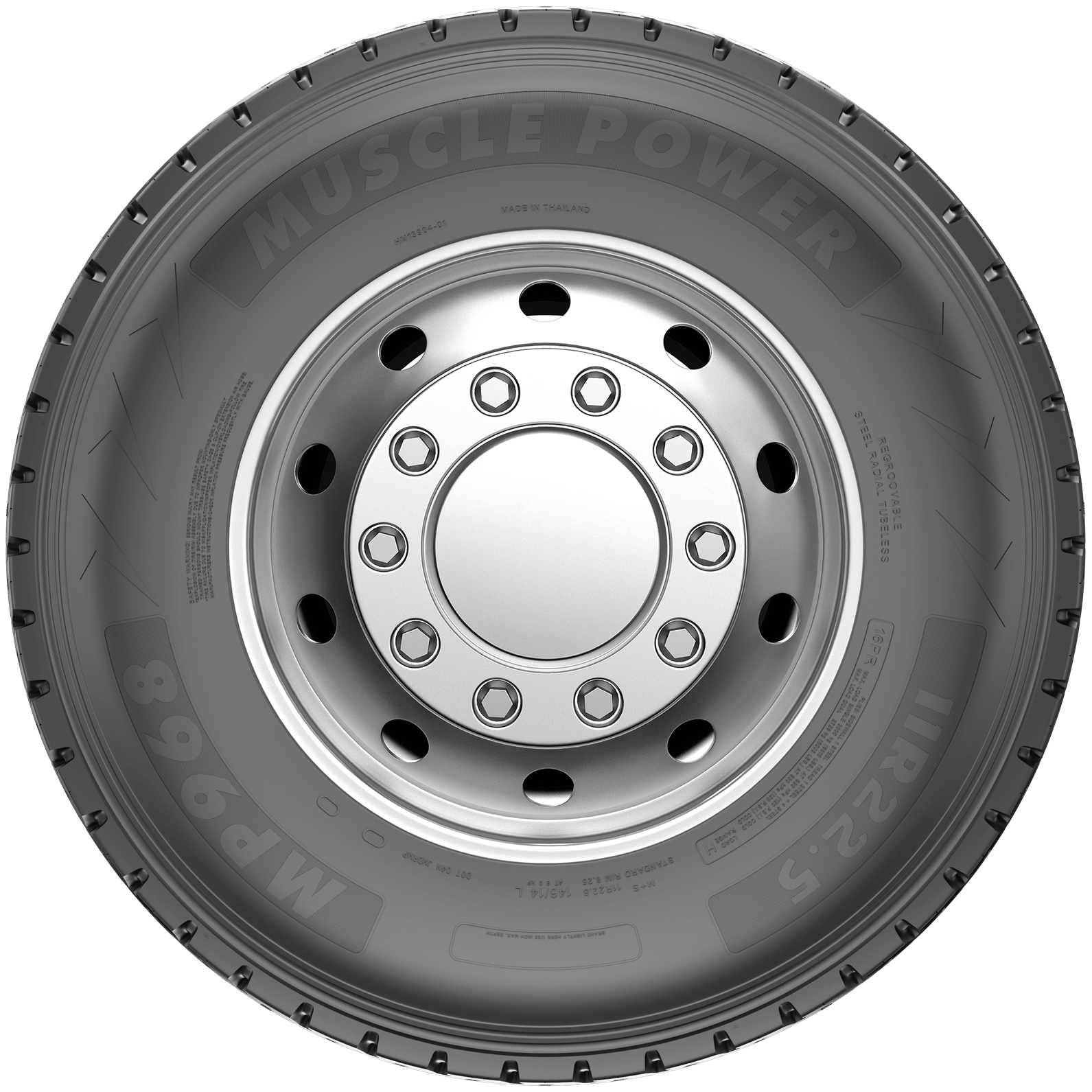
 MP968 Angle View
 MP968 Tread View
Open Shoulder Commercial Drive Tire
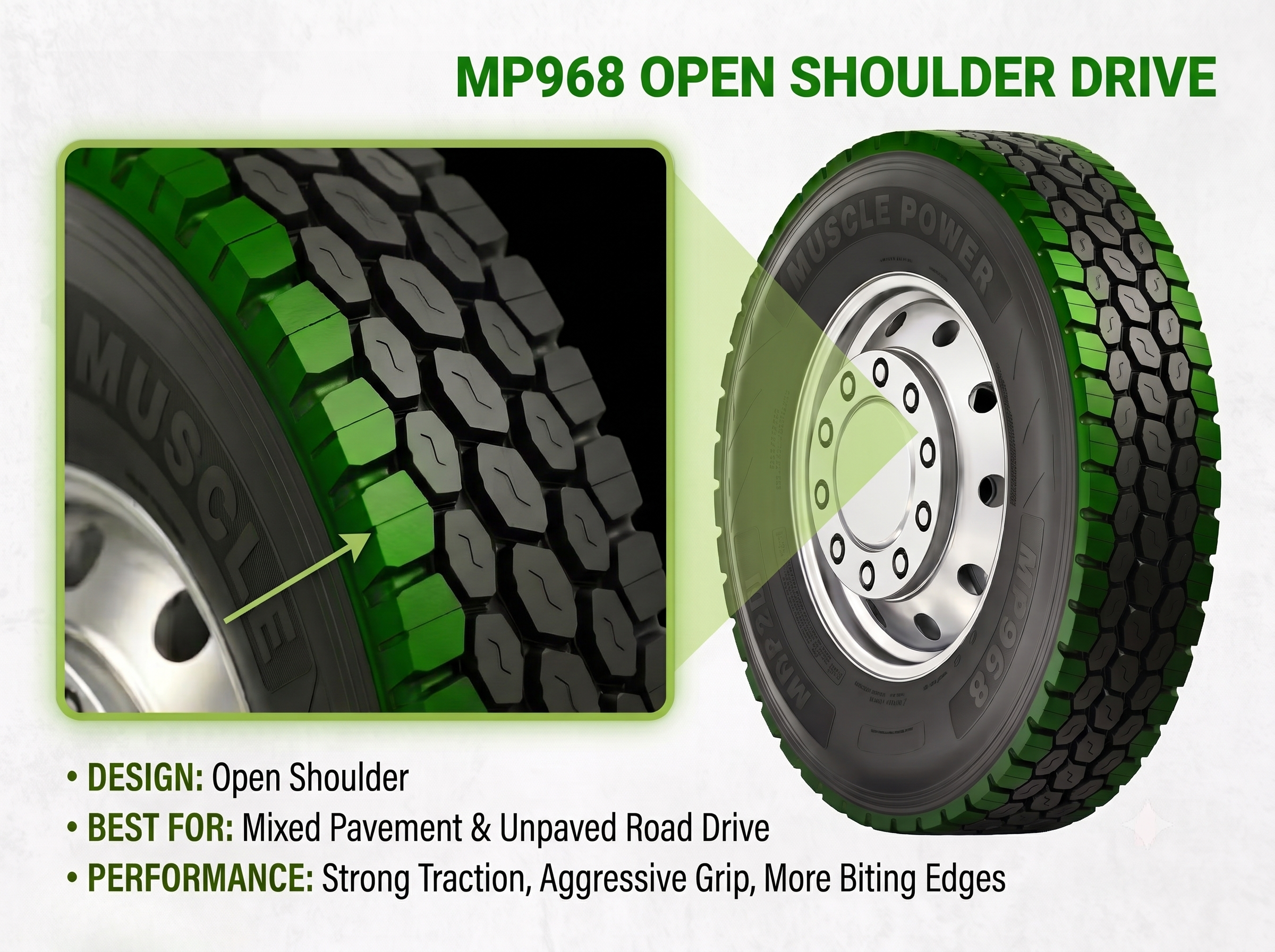
The MP968 is an open shoulder commercial drive tire designed for applications where additional traction and tread bite are important. The open shoulder pattern creates more biting edges, helping the tire grip the road in regional, wet, and more demanding drive-position conditions.
MP968 also uses 28/32 tread depth, deep grooves, a wide footprint, stone ejectors, and a strengthened carcass structure to support traction, stability, and casing durability.
MP968 is the preferred Muscle Power drive tire when the application needs more open-shoulder traction, stronger tread bite, and grip in regional or demanding road conditions.
Adds biting edges for traction in regional, wet, mixed, and demanding drive-position conditions.
Provides deep original tread for traction and first-life drive tire performance.
Help the tire maintain grip and evacuate road debris through demanding routes.
Supports road contact, traction, and drive-position stability under load.
Help reduce stone retention and protect the casing from damage.
Improves load capacity, casing stability, and commercial-duty durability.
| Size | Ply Rating | Load Range | Load Index | Speed Symbol | Outside Diameter | Section Width | Tread Depth 32nds | Rim | Single Max Load/Pressure | Dual Max Load/Pressure | Static Load Radius | Revs Per Mile | Weight lbs | Tire Type |
|---|---|---|---|---|---|---|---|---|---|---|---|---|---|---|
| 11R22.5 | 16 | H | 146/143 | L | 41.77 | 11 | 28 | 8.25 | 6610/120psi | 6005/120psi | 20.1 | 486 | 119.3 | TL |
Drive Pattern Comparison
MP967 is a closed shoulder pattern for stable wear, long-mileage highway performance, and consistent road contact. MP968 is an open shoulder pattern for stronger tread bite, additional traction, and more demanding drive-position conditions.
| Model | Shoulder Type | Best For | Main Advantage |
|---|---|---|---|
| MP967 | Closed Shoulder | Long-haul and regional highway applications | Stable wear and long original tread life |
| MP968 | Open Shoulder | Regional, wet, mixed, and demanding drive applications | Stronger traction and tread bite |
Get manufacturer-direct access to Muscle Power commercial truck tire programs.
Buying for a single truck? Use Buy Online when available or contact a local Muscle Power dealer.
Drive Tire Education
Drive tire shoulder design affects traction, wear, stability, and application fit. The right choice depends on where the truck works, how it is loaded, and how much traction the tire needs beyond normal highway driving.
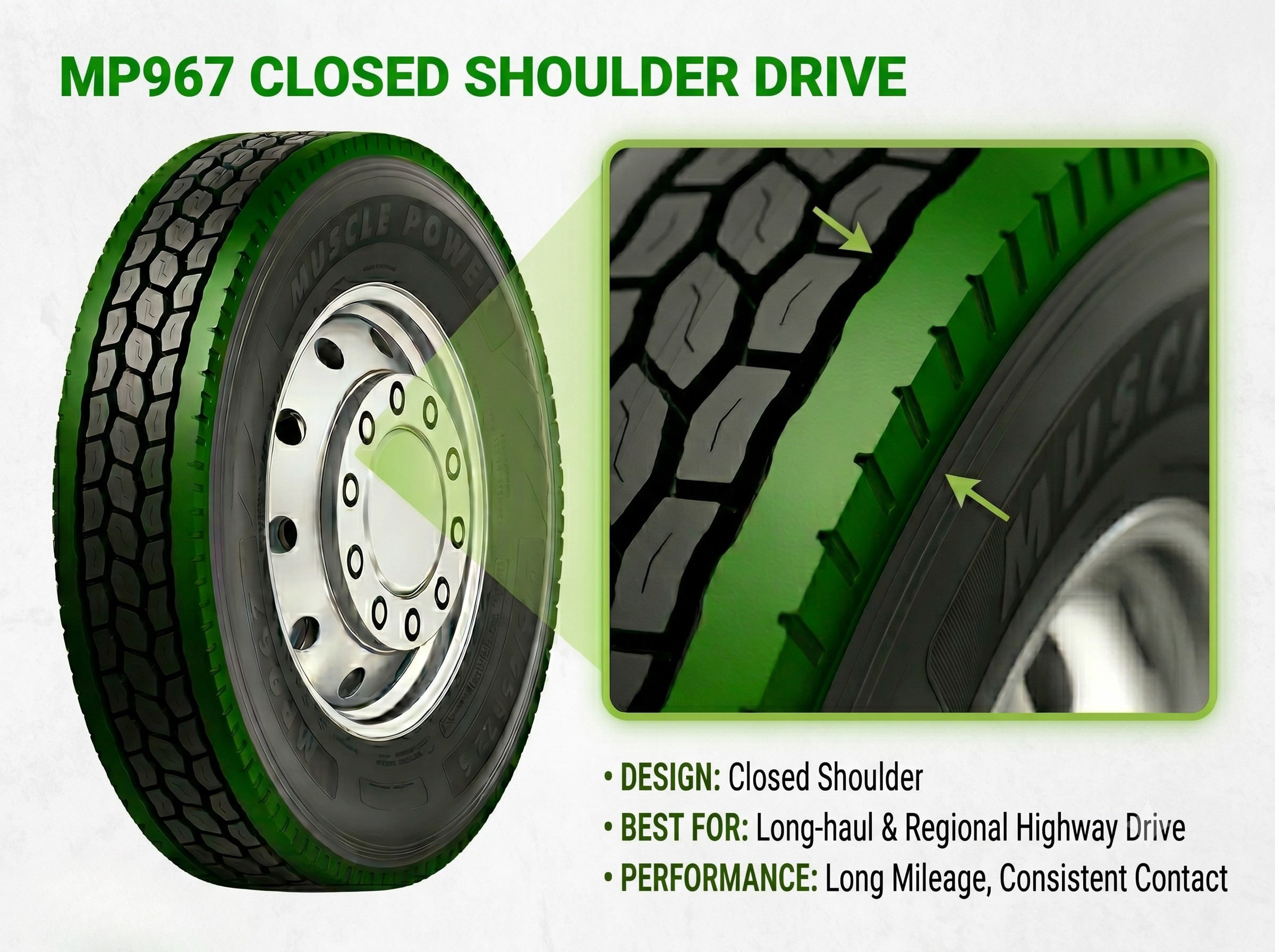
The MP967 Closed Shoulder Drive Tire is designed for long-haul and regional highway applications where stable wear, consistent road contact, and long original tread life are the priority. Its closed shoulder pattern helps maintain a steady footprint, making it a strong choice for fleets that spend most of their miles on paved highways, regional routes, and predictable road surfaces.
The MP968 Open Shoulder Drive Tire is built for applications that need more traction, more tread bite, and stronger grip in demanding drive-position conditions. Its open shoulder pattern creates additional biting edges, helping the tire perform in local, regional, wet, mixed-surface, and vocational applications.
MP968 is especially well suited for dump trucks, concrete trucks, construction-site deliveries, and local fleets that move between pavement, gravel, dirt, and rougher job-site surfaces. With deep 28/32 original tread, a robust rubber package, and 5-belt commercial truck tire construction, MP968 is positioned as one of the strongest value options in its class for fleets that need open-shoulder traction without paying premium-brand pricing.
For fleets focused on highway stability and long mileage, MP967 is usually the better fit. For fleets that need stronger traction, more grip, and better performance in demanding local or vocational work, MP968 is the better choice. The MP968 is currently offered in 11R22.5, making it especially focused for common vocational and regional drive-tire applications.
Both MP967 and MP968 commercial truck drive tires are built with a deep 28/32 original tread depth. Drive-position tires typically require deeper tread than steer or trailer tires because they must deliver traction, handle engine torque, support braking force, and carry loaded miles under demanding fleet conditions.
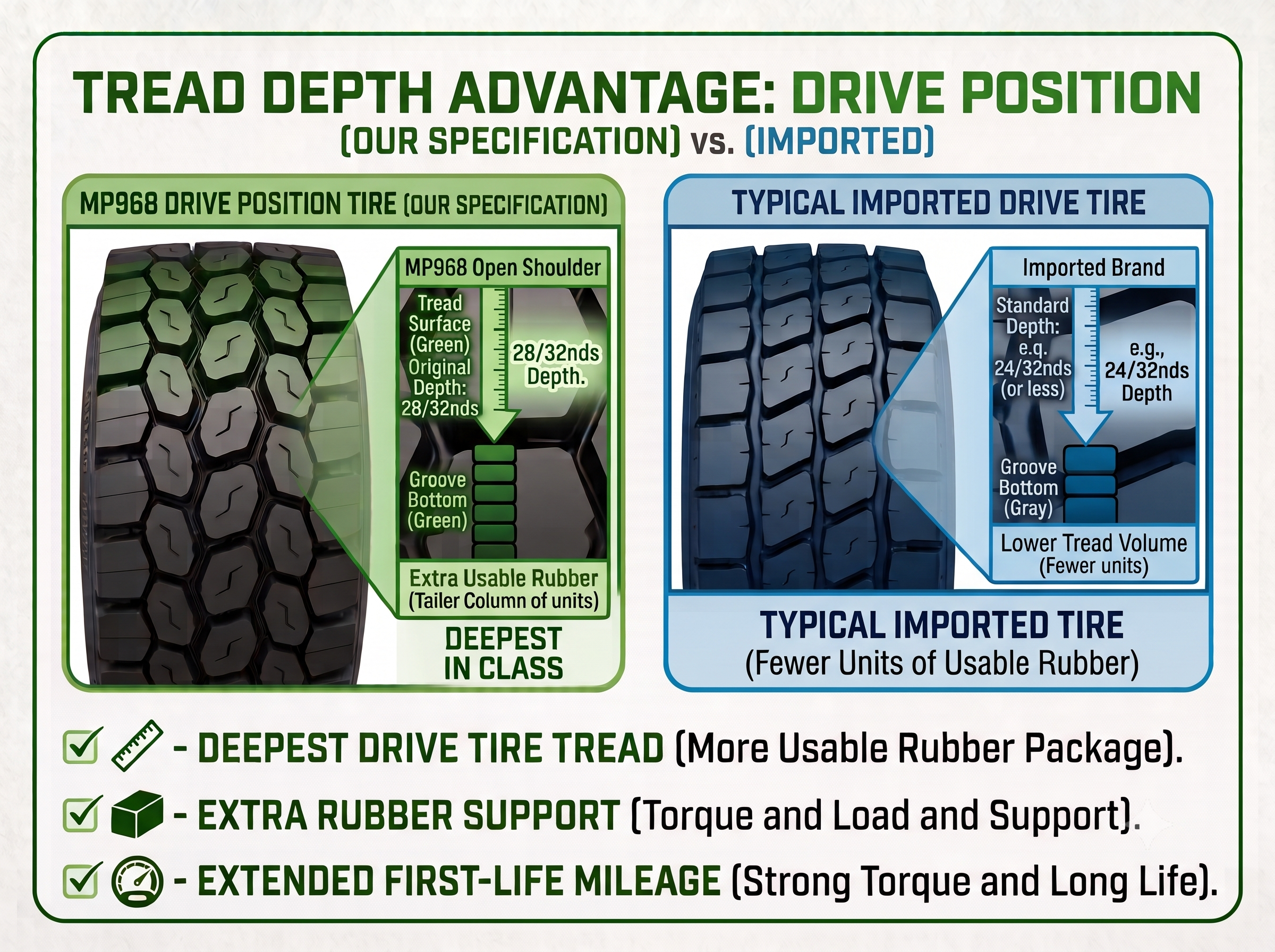
A deeper original tread package gives the tire more rubber volume available before removal.
More tread depth can support longer first-life mileage when the tire is properly matched, inflated, and maintained.
Drive tires need tread depth to help handle torque, braking force, loaded miles, wet roads, and regional work.
A deeper tread package can help fleets improve tire value when wear conditions and maintenance are managed correctly.
A 28/32 tread depth gives the tire a larger usable rubber package before removal. In practical fleet terms, that means more tread volume available for traction, wear life, and first-life mileage potential. This is especially important for semi truck drive tires that operate under torque, heavy loads, heat, wet roads, regional routes, and long highway miles.
Compared with many standard imported drive tires that may start with a shallower tread package, MP967 and MP968 are positioned to give fleets more usable rubber from the beginning. More original tread depth can help improve value per mile, but tread depth alone does not determine tire life. Real-world mileage also depends on route type, load weight, inflation pressure, alignment, driving style, road surface, climate, and maintenance practices.
For highway and regional drive-position use, the MP967 uses its 28/32 tread depth to support stable wear, consistent road contact, and long original tread life. For open-shoulder traction applications, the MP968 uses the same deep 28/32 tread depth to provide stronger tread bite, grip, and usable rubber for vocational, regional, and mixed-surface conditions.
For fleets, dealers, and distributors comparing commercial truck drive tires, the 28/32 tread depth on MP967 and MP968 is a key part of the Muscle Power value proposition: a deeper original tread package, strong drive-position traction, and competitive first-life performance at an aggressive price point.
The casing is the foundation of a commercial truck drive tire. In drive-position service, the casing has to absorb torque, braking force, road shock, heat, and heavy loads while helping the tire stay stable and perform consistently.
Four steel belts plus one cap ply for commercial-duty strength.
Built to handle torque, load, heat, and road impact.
Helps support even wear and controlled performance.
Helps reduce stone retention and casing damage risk.
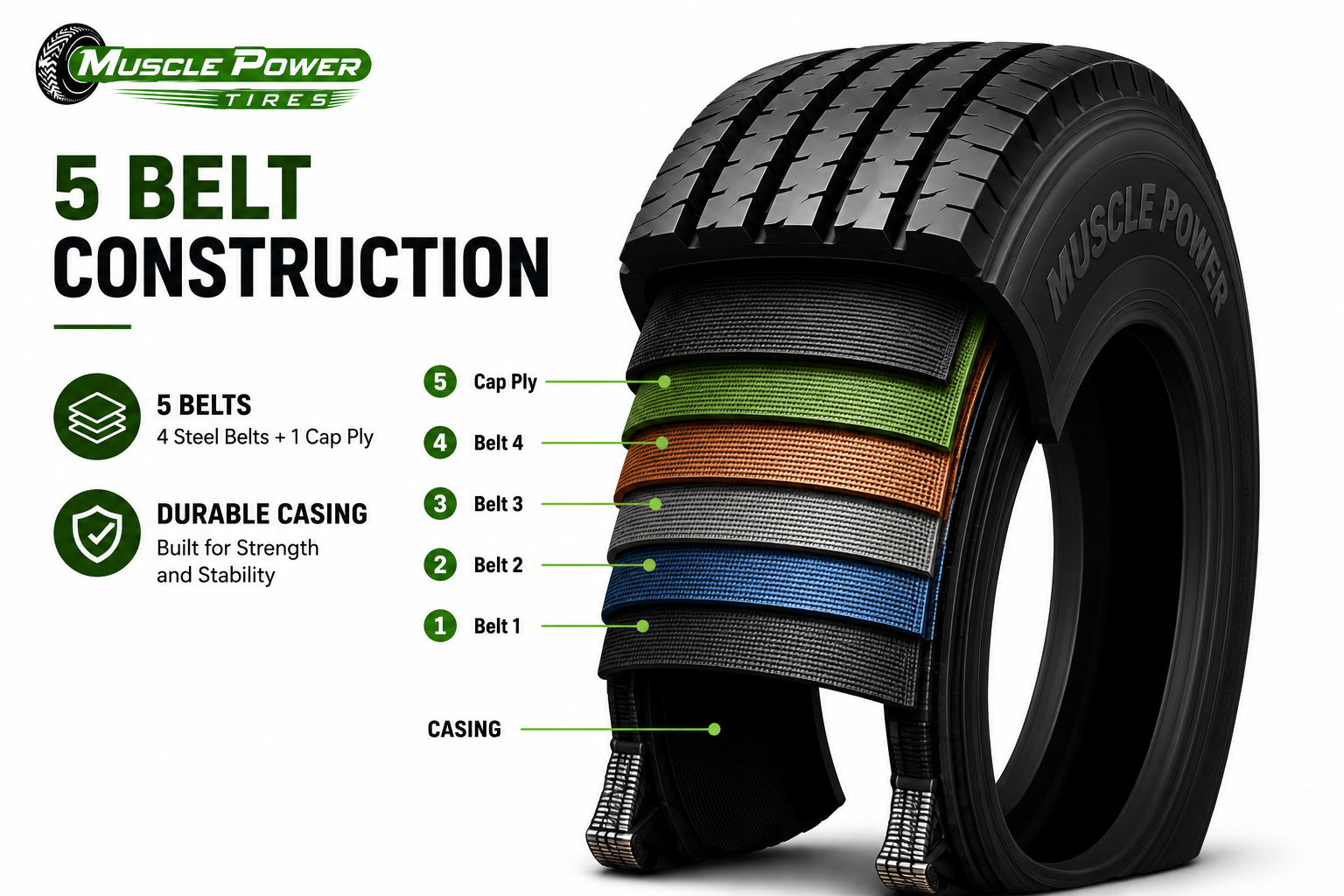
Muscle Power drive tires are built with a 4+1 belt construction: four working steel belts plus one cap ply over the belt package. This 5-belt structure helps support casing strength, tread stability, heat control, and durability for demanding commercial truck tire applications.
A stronger belt-and-casing package helps the tire resist distortion under load, support even wear, and maintain consistent performance in highway, regional, and mixed-service conditions. This construction approach is one of the reasons Muscle Power drive tires deliver premium-style structural value while remaining competitively priced.
Stone ejectors in the tread grooves also help reduce stone retention and lower the risk of stone drilling damage, which can help protect the casing in more demanding service environments.
Like any commercial truck tire, long-term casing value still depends on the application, inflation pressure, load management, alignment, rotation, and maintenance program. But the underlying 5-belt construction gives MP drive tires a stronger structural foundation for commercial use.
Commercial truck tire specifications help fleets, dealers, and distributors match the tire to the correct truck, axle position, load requirement, rim size, inflation pressure, and application. On a drive tire, the key specs usually include tire size, ply rating, load range, load index, speed symbol, tread depth, rim width, maximum load, inflation pressure, revolutions per mile, and tire weight.
The goal is not simply to choose the biggest number on the spec sheet. The goal is to choose the tire that correctly matches the truck, axle, route, load, road condition, and maintenance program.
Identifies the tire fitment, such as 11R22.5, 11R24.5, or 295/75R22.5. The tire size must match the wheel, axle position, and vehicle requirements.
An older strength-rating term used to compare tire load categories. In modern radial truck tires, 14-ply and 16-ply usually do not mean the tire literally has 14 or 16 physical body plies.
Shows the tire's load/strength category. For many commercial truck tires, Load Range G is commonly associated with 14-ply rating, while Load Range H is commonly associated with 16-ply rating.
The most precise way to read rated load capacity. When two numbers appear, such as 146/143, the first is usually the single-tire load index and the second is the dual-tire load index.
Shows the tire's speed rating category. On MP drive tire specifications, speed symbol L indicates a rating up to 75 mph when the tire is properly loaded, inflated, and used within service conditions.
TL means tubeless, which is the standard construction used on modern commercial truck tire and wheel assemblies.
Shows the original tread depth when the tire is new. MP967 and MP968 use a deep 28/32 drive-position tread package for traction, torque, and first-life value.
Shows the maximum rated load at the required inflation pressure for that tire size and application. A tire can only carry its rated load when it is properly inflated and correctly applied.
Ply rating is one of the most misunderstood commercial truck tire specifications. In modern radial truck tires, "14-ply" and "16-ply" are best understood as load range / strength-rating categories, not literal counts of physical tire plies.
For example, a common Load Range G / 14-ply commercial truck tire may carry a load index such as 144/141. That equals about 6,175 lb in single use and 5,675 lb in dual use. A common Load Range H / 16-ply commercial truck tire may carry a load index such as 146/143. That equals about 6,610 lb in single use and 6,005 lb in dual use.
The 16-ply-rated tire does carry more load capacity, but the practical question is whether the truck actually needs the extra capacity for that axle position and application.
Federal Interstate limits are generally 20,000 lb for a single axle, 34,000 lb for a tandem axle, and 80,000 lb gross vehicle weight, subject to the bridge formula and applicable state or permit rules.
Federal Interstate tandem axle limit: 34,000 lb
Typical tandem group: 8 tires
Required per tire: 4,250 lb
14-ply / Load Range G example: Load Index 141 dual = about 5,675 lb per tire
5,675 x 8 = 45,400 lb tire capacity
Already above the general 34,000 lb tandem axle limit.Federal Interstate single axle limit: 20,000 lb
Dual tires on axle: 4 tires
Required per tire: 5,000 lb
14-ply / Load Range G example: Load Index 141 dual = about 5,675 lb per tire
Still above the 20,000 lb single axle example.Actual legal load limits, bridge formula rules, state rules, permits, axle ratings, tire size, inflation pressure, and application requirements must always be checked.
That is above the general 34,000 lb federal tandem axle limit. On a single axle with dual tires, 20,000 lb divided by 4 tires equals 5,000 lb required per tire. A 14-ply / Load Range G tire with a dual load capacity around 5,675 lb per tire is also above that example.
This is why, for many drive and trailer dual-tire applications, 16-ply is not automatically better just because the number is higher. The better question is whether the tire's load index, inflation pressure, rim compatibility, axle position, and actual application match the truck.
Where Load Range H / 16-ply can matter more is on steer tires or heavier single-tire applications. A steer axle normally uses only two tires, so each tire carries a much larger share of the axle load. In those cases, a higher load index can provide important additional capacity.
For MP drive tires, the correct choice should be based on the full specification: tire size, load range, load index, single/dual load rating, inflation pressure, rim width, axle position, route type, and load requirement - not only the ply number.
Load Range is a tire strength and load-category system. In older tire language, it is tied to "ply rating," but modern radial truck tires usually do not contain that exact number of physical plies. Instead, the load range letter describes a strength category used together with tire size, load index, inflation pressure, and rim specification.
For many standard commercial truck drive and trailer tires, Load Range G and Load Range H are the most common categories. Load Range G is commonly associated with 14-ply-rated sizes, while Load Range H is commonly associated with 16-ply-rated sizes.
The important point is that load range by itself does not give the complete carrying capacity. The actual rated pounds are shown by the load index and depend on tire size, single or dual use, rim, and required inflation pressure.
Load Range H is a commercial truck tire load-range category commonly associated with a 16-ply rating. In modern radial truck tires, "16-ply" usually does not mean the tire literally has 16 physical body plies. It means the tire belongs to a higher strength/load category than a 14-ply-rated Load Range G tire.
For example, a common 11R22.5 Load Range H commercial truck tire may use a load index such as 146/143. In that marking, 146 is the single-tire load index and 143 is the dual-tire load index. Load index 146 equals about 6,610 lb in single use, while load index 143 equals about 6,005 lb in dual use.
Another common Load Range H example is 11R24.5 with a 149/146 marking. Load index 149 equals about 7,160 lb in single use, while load index 146 equals about 6,610 lb in dual use.
That is why Load Range H should not be judged by the "16-ply" phrase alone. The correct way to read it is: tire size + load range + load index + single/dual rating + inflation pressure + rim compatibility.
The speed symbol is part of the tire service description. It identifies the tire's speed rating category when the tire is properly loaded, properly inflated, correctly installed, and used within the tire manufacturer's conditions.
On MP drive tire specifications, the speed symbol is commonly listed as L. Speed symbol L means the tire is rated up to 75 mph under the proper load, pressure, and service conditions.
This does not mean a truck should always be driven at 75 mph. Legal speed limits, fleet safety policies, road conditions, load weight, tire pressure, heat, and maintenance all matter. It also does not mean that a higher speed symbol is automatically better for every commercial truck application.
For drive-position tires, the tire must balance speed rating with load capacity, tread depth, casing strength, heat control, and application fit.
For most U.S. highway and regional commercial truck use, speed symbol L is a common on-highway truck tire speed rating. The key is to keep the tire properly inflated for the load and to operate within legal and safe driving conditions.
Load Range H = load / strength category, commonly 16-ply rated.
Speed Symbol L = speed rating category, commonly up to 75 mph.
They are different markings and explain different things.
TL means tubeless. Tubeless commercial truck tires are designed to hold air without an inner tube when mounted on the correct tubeless wheel assembly. This is the standard configuration for modern commercial truck tire and wheel applications.
Always match tire size, load range, load index, rim width, inflation pressure, and maximum load to the vehicle manufacturer requirements and the actual application. The correct choice depends on truck type, axle position, load weight, route, road conditions, speed, and maintenance program.
Tire Position Guide
Compare Muscle Power tire options by axle position: Steer Tires for control and front axle stability, Trailer Tires for scrub resistance, All Position Tires for versatile fleet use, and Intermodal Tires for container, chassis, port, and drayage work.
Drive Tire FAQ
For long-haul and steady regional highway use, MP967 is usually the better fit. The MP967 closed shoulder drive tire is designed to support stable wear, consistent road contact, and long original tread life on paved highway routes. Its closed shoulder pattern helps reduce unnecessary tread movement, making it a strong option for fleets that prioritize mileage, even wear, and dependable drive-position performance over aggressive off-road traction.
Use MP967 when the truck spends most of its time on highway lanes, regional delivery routes, and predictable paved surfaces where stability and cost per mile are the main priorities.
When traction, tread bite, and grip are the priority, MP968 is usually the better fit. The MP968 open shoulder drive tire is designed with more open tread voids and additional biting edges to support traction in wet, regional, vocational, and mixed-surface applications.
MP968 is a strong choice for dump trucks, concrete trucks, construction-site deliveries, local fleets, and trucks that move between pavement, gravel, dirt, and rougher job-site surfaces. It is built for drive-position applications where stronger grip, open-shoulder traction, and demanding road conditions matter more than maximum highway-style wear stability.
Muscle Power drive tires are positioned as a high-value commercial truck tire option for fleets, dealers, and distributors that want stronger performance than many low-cost imported truck tires without premium-brand pricing. MP drive tires focus on deep original tread, 5-belt commercial truck tire construction, robust casing support, stone ejectors, and drive-position tread patterns designed for North American highway, regional, and vocational applications.
The MP967 closed shoulder drive tire is built for stable wear and long-mileage highway performance, while the MP968 open shoulder drive tire is built for stronger traction and more demanding drive-position conditions. This gives buyers a clearer choice between highway-focused mileage and open-shoulder traction.
Muscle Power Tires is a manufacturer-direct commercial truck tire brand. We work primarily with wholesale distributors, tire dealers, and large truck fleets. For single-truck or small retail purchases, please buy online when available or contact a local dealer/distributor carrying Muscle Power products.