Four tires on the axle
A drive or trailer axle has four tires, two pairs of duals. The Interstate stops that axle at 20,000 lb. A tandem stops at 34,000 lb.

Load Ratings
A lot of import brands lead with 16-ply. Bigger number, heavier tire, better deal. For a fleet running legal highway loads, that pitch is marketing. It does not matter on the drive. It does not matter on the trailer. It matters on the steer.
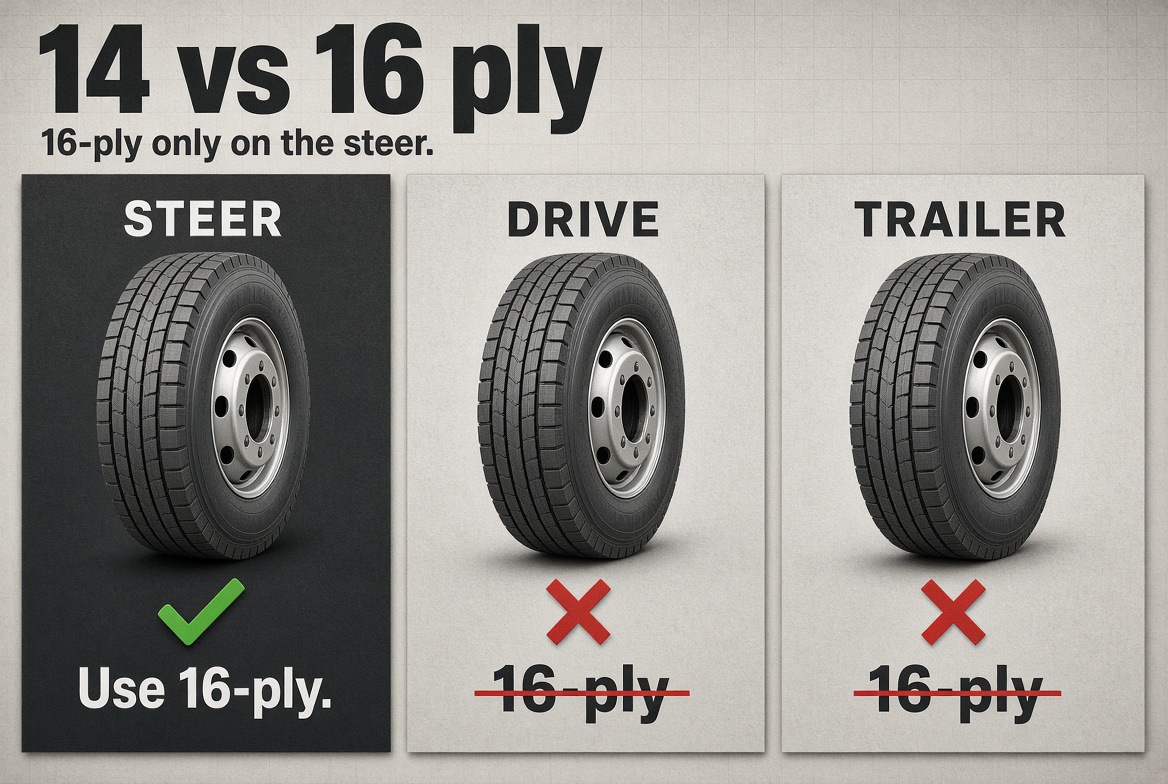
A purchase order that says “16-ply all around” is buying a sticker. The number looks stronger. On a legal highway truck it does not haul one extra pound on the drive or the trailer. Those axles already have four tires. The scale stops them before a 14-ply set runs out of capacity.
That is the whole trick in the import pitch. A 16 is bigger than a 14, so the tire must be the better buy. Bigger ply, more load, safer fleet. The missing half is the axle. Capacity you cannot legally put on the truck is not capacity. It is a line on a flyer.
A drive axle runs duals. Two tires on the left, two on the right. Four tires share that axle. A trailer axle is built the same way. The Interstate stops any one of those axles at 20,000 lb and a tandem at 34,000 lb (23 CFR 658.17). A 14-ply Muscle Power tire in 295/75R22.5 is rated 5,675 lb as a dual. Four of them add up to 22,700 lb. The axle is still illegal past 20,000 lb. Eight of those tires on a tandem are far above the 34,000 lb cap. A 16-ply tire adds a little more room on paper. It does not move either cap. That is why drive and trailer have 16-ply crossed out.
Federal axle weights are in 23 CFR 658.17. A tire still cannot be loaded past the weight on the sidewall, under 49 CFR 393.75.
The front axle does not get that four-tire split. Two tires carry the whole steer load. A 14-ply pair on the front is about 12,350 lb. A 16-ply pair, the MP991 in 11R22.5, is about 13,220 lb. Front axles are often rated around 12,000 to 13,200 lb. A steer rated near 13,200 lb needs the 16-ply pair. Those two tires should be a steer tire. A drive tread with a 16 on the sidewall is still the wrong tire for the front.
16-ply on the steer when the front axle rating needs it. 14-ply on the drive and the trailer. On this sheet, 14-ply is Load Range G and 16-ply is Load Range H. The number is the class name, not 14 or 16 layers of fabric. Trailer fit is the MP993. Drive fits are the MP967 and MP968. An overweight permit is a different sheet.
Steer: MP991, 11R22.5, 16-ply, Load Range H, if the front axle is rated near 13,200 lb. Drive: MP967 or MP968, 14-ply. Trailer: MP993, 14-ply. Request pricing. The size code is explained in how to read commercial truck tire specifications.
A drive or trailer axle has four tires, two pairs of duals. The Interstate stops that axle at 20,000 lb. A tandem stops at 34,000 lb.
A 14-ply Muscle Power tire, the 295/75R22.5, is rated 5,675 lb in dual use. Four of them add up to 22,700 lb. The axle is still illegal past 20,000 lb.
A 16-ply tire adds a little more room on paper. It does not move the 20,000 lb axle cap, and it does not move the 34,000 lb tandem cap.
A steer axle has two tires, not four. A 14-ply pair on the front is about 12,350 lb. A 16-ply pair, the MP991 in 11R22.5, is about 13,220 lb. Front axles are often rated around 12,000 to 13,200 lb. At the high end, the 14-ply pair is the short leg.
That is Load Range G on the Muscle Power sheet. Trailer fit is the MP993. Drive fits are the MP967 and MP968. Ply does not pick the tread.
| Position | Tire | Ply | What the pair or set covers |
|---|---|---|---|
| Steer | MP991 11R22.5 | 16-ply, Load Range H | About 13,220 lb on two tires |
| Steer | 295/75R22.5 | 14-ply, Load Range G | About 12,350 lb on two tires |
| Drive or trailer | 295/75R22.5 | 14-ply, Load Range G | 22,700 lb on four duals, against a 20,000 lb axle cap |
On our sheet, 14-ply is Load Range G and 16-ply is Load Range H. The ply count is the class name. It is not 14 or 16 layers of fabric.
Use 16-ply when the front axle is rated near 13,200 lb. Those two tires should be a steer tire, not a drive tread with a 16 on the sidewall.
Use 14-ply on axles that run duals under the federal axle cap. Spending the 16-ply premium on eight drive tires does not raise a legal tandem from 34,000 lb.
An overweight permit is a different load sheet. A normal highway fleet does not need 16-ply on the drive or the trailer.
Size, position, and monthly volume.
It is a higher load class. On drive and trailer axles that extra class does not raise the legal load.
On the steer. Two tires carry that axle.
Four duals at 5,675 lb are 22,700 lb. A legal Interstate axle stops at 20,000 lb.
No. It is the load-class name. On our sheet, 14-ply is Load Range G and 16-ply is Load Range H.
No. The class can be right and the tread still wrong. Use the MP991 on the front.
Headquarters are in Chicago, and the wholesale ask is the axle, the size, and the monthly volume.